LEDS are Planting New Growth Opportunities in the World of Urban Farming
By Paul Golata & Karthi Gopalan, for Mouser Electronics
Horticulture is the branch of agriculture that deals with the art, science, technology, and business of growing plants. Urban farming can be done in a variety of ways, through commercial greenhouses, corporate indoor urban farms, vertically stacked farming configurations, as well as via home and do-it-yourself commercial and recreational farming.
Densely-populated and ever-growing metropolises and megacities are looking towards urban farming, as a means to alleviate their existing challenges, to speed-up the farm-to-table process (harvesting, storage, processing, packaging, sales and consumption), and to improve the overall quality of life.
A farm-to-table movement has risen with recent changes in attitude about food safety, freshness, seasonality, and small-farm economics. Advocates of the farm-to-table model frequently cite as their motivation the scarcity of fresh, local ingredients, poor flavor of ingredients shipped from afar, poor nutritional integrity of shipped ingredients, the encroachment of genetically modified foods, the disappearance of small family farms of heirloom and open-pollinated fruits and vegetables, and the dangers of a highly centralized food-growing and -distribution system. These trends are expected to propel the growth of Urban Farming regardless of whether one may be involved in large scale farming or recreational indoor and outdoor gardening or is simply a technology enthusiast who wants to educate themselves.
Plants use a process called photosynthesis to convert carbon dioxide (CO2) and water (H2O) with light energy, most often from sunlight, into chemical energy (carbohydrates, CxHxOx), that the plant uses for fuel, and oxygen (O2). Farming, over the past millennia, has been exclusively outdoors in order to obtain the necessary sunlight for growing plants. Breakthroughs in light-emitting diode (LED) technology are enabling humanity opportunities to grow plants in ways that previously were not possible in countries that sport terrains that are so harsh and arid that traditional outdoor farming historically was very hard to realize. The growing and harvesting of plants produced indoors and in greenhouses is set to greatly increase over the next several decades. This is in response to mankind’s ability to guide the best type of lights efficiently and effectively upon plants. Plant growth will greatly benefit by the controls that can be realized through urban farming methods.
According to the Food and Agriculture Organization of the United Nations (FAO), urban farming is becoming increasingly popular throughout the world, with an estimated 800M of the world’s 7.4B people (@ 11%) practicing it. Current annual growth rate projections for urban farming exceed twenty-five percent. The continent of Europe is the present leader in this field. It is expected that the Asia Pacific region, which is undergoing the faster rate in the world of rural to urban development, will ultimately be the global leader within the time span of the next generation.
Growing plants through urban farming eliminates the need for long-haul transportation and distribution of food, and places it closer from inception to the consumer. As issues related to lighting, power, and runoff are successfully dealt with, the adoption of urban farming methods will quicken.
As the continued inflow of humanity from rural to urban centers continues, city buildings, out of necessity, are becoming more crowded and being built higher. Urban farming may take advantage of multiple floor buildings by developing farms at various floor levels throughout the building, to derive maximum utility from scarce urban space. Plants that do not need a lot of light, such as tomatoes and spinach, are logical crops for such urban farms. In general, vegetables, with their short production cycles—from planting to final harvest—are ideal candidates for consideration.
Color LEDs Growing Opportunities by Enabling Indoor Photosynthesis
Urban farming typically employs artificial light as opposed to natural sunlight. With the development of a wide variety of color LEDs the urban farmer is no longer dependent on natural light sources. Due to their ability to be electronically controlled LEDs can now provide custom tailored lighting solutions to maximize plant growth regardless of the prevailing weather conditions outside. The urban farmer know has the opportunity to finely tune the wavelength spectrums of light and the exposure timing for the plants. While exposing the plant to larger components of red or blue wavelengths to achieve maximum growth, maximum energy efficiency can be obtained through properly selected solid-state lighting (SSL) and power controls.
Success in urban farming requires the best color LEDs. Lumileds, a $2B supplier of game-changing LEDs, has long been recognized as a preeminent supplier of color LEDs, and provides wavelength specific LEDs for horticultural applications. Engineered for the most demanding applications, all products are built on Lumileds’ high-performance LED technology—including market-leading phosphors—delivering unmatched efficacy, superior color control and unprecedented ease of deployment.
Nearly a decade ago, Lumileds launched the LUXEON Rebel Color Line, the market-leading color LEDs that have been transforming lighting designs ever since. Today, Lumileds delivers the broadest range of colors available, from far red to cyan, UV and even lime and mint. Lumileds offers the most comprehensive family of mid- and high-power color LEDs, with the industry's best quality of light.
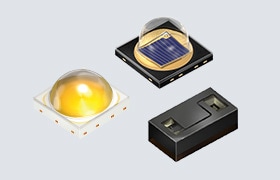
Lumileds offers two product families that are particularly well-suited for urban farming applications. The LUXEON 3535L Color Line LEDs (Figure 1) is a mid-power LED that is available in six (6) colors and are packaged in an industry standard 3.5 mm x 3.5 mm footprint. Three of these six colors are well suited for horticulture applications: Royal Blue (450nm), Blue (475nm), and Red (625nm). Its single die and single source architecture provides excellent optical control while its common focal length with LUXEON Rebel and LUXEON Z Color LEDs allows for easier optical design. Simple singular ON/OFF horticultural lighting configurations can benefit from the use of the LUXEON 3535L LED.
Figure 1: LUXEON 3535L Color Line
Lumileds has introduced the LUXEON C Color Line LEDs which are high power LEDs. They come in a variety of colors with a single focal length that allows flawless color mixing which thus maximizes optical efficiency and removes halos. Its low dome design eliminates trade-offs between flux and source size and it provides the industry’s lowest thermal resistance helping engineers lower heat sink costs while achieving greater light output. Its small symmetrical package enables dense packing and limits the impact of rotation during reflow. Urban farming applications will greatly benefit from colors including: Royal Blue (450 nm), Blue (475 nm), Red (625 nm), Far Red (730 nm) and White. LUXEON C LEDs are excellent for multi-color switchable and full color tunable (FCT) applications involving urban farming.
Figure 2: LUXEON C Color Line
Figure 3: Lumileds Color LEDs – Horticulture: LUXEON 3535L Color and LUXEON C
LED Drivers Growing Opportunities by Controlling Light
LEDs, as solid-state lighting devices, require power to operate and control them. The control of Lumileds’ color LEDs is best done by a firm that understands how to properly power and run them. Infineon Technologies is a $6.3B semiconductor company that is a recognized technology leader in power. This technology and innovation leadership has enabled them to achieve the number one ranking in semiconductor power products. Infineon is focused on making life easier, safer, and greener—with technology that achieves more, consumes less power, and is accessible to everyone.
To successfully design horticulture and urban lighting with color LEDs, efficacy (Luminous FluxOUT/PowerTOTAL), power efficiency (POUT/PIN) and design flexibility are critical. The interrelationships between these factors often result in design tradeoffs for engineers. In addition to electronic power issues, designers also desire that systems have proper thermal management considerations taken into account in order to ensure long lifetime for the colored LEDs and electronics employed in the SSL system. Having to add external thermal sensors, such as negative temperature coefficient (NTC) or negative temperature coefficient (PTC) thermistors adds to the SSL system’s cost and complexity. To solve these problems, Infineon has the perfect solutions to work in combination with Lumileds’ LUXEON color LEDs.
Single-Color String Topologies
<100 Watts
The Infineon ICL8105 is a great fit for single-color topologies that are under one hundred watts (<100W). It is a high performance configurable single-stage Flyback controller with Power Factor Correction (PFC) for constant output current LED driver. It supports universal AC input voltages while its digital core and its advanced control algorithms provide multi-operation modes such as quasi-resonant mode, discontinuous conduction mode or active burst mode. With this functionality and smooth transition between the operation modes, the controller delivers high efficiency (91%), high power factor (0.90) and low harmonic distortion (<10%) through the entire load range. The optional active burst mode control scheme significantly extends the dimming range and is aligned to the line frequency avoiding effects like flicker or shimmer while also reducing audible noise.
>100 Watts
The ILD6000 DC/DC LED Driver Series is a family of devices are unique step-down (BUCK) converters that allow input operation up to 60VDC which is the maximum Safety Electrical Low Voltage (SELV). ILD stands for Infineon Laser Driver. Able to handle a wide load of current up to 1.5A they can work well with from one to eighteen colored LEDs, with little to no change in the external component count. The ILD series offers excellent power efficiencies, achieving 98% efficiency, so that electric power is not wasted. Due to its fast 1MHZ switching speed the associated inductor size required is minimized. This benefit combined with the integrated MOSFET allows for easy and simple designs which enable small form-factor solutions. Excellent solutions for color LED applications within the ILD6000 series include the ILD6070 (60VDC, 0.7A) and the ILD6150 (60VDC, 1.5A). These solutions have their own internal thermal sensor providing designers a fully integrated solution. This means there is no need for costly external NTC/PTC device. They also provide options to engineers by allowing them to forego the internal sensor and incorporate an external thermal NTC/PTC device, if they desire maximum design flexibility.
The Infineon BCR450 Power LED Driver IC can be used in conjunction with the ILD6000 series for DC/DC topologies greater than one hundred watt (>100W). It works well with both single- and multi-color topologies. It can be triggered by an external signal which is also suitable to regulate brightness of the LEDs through PWM dimming.
Multi-String Topologies
Full Color Tuning
Multicolor and full color tuning (FCT) LED strings require precise control in order to ensure the proper amount of specific colored wavelength is provided to the plants. This is best accomplished through employing a microcontroller (MCU). Infineon is a leader in providing microcontrollers for color LED applications such as urban farming. The Infineon XMC Series is a 32-bit ARM® Cortex™-M industrial microcontroller. These MCUs feature application-specific features for lighting, motor control, and power conversion.
Brightness and Color Control Unit
The MCUs featuring application-specific features for lighting feature a Brightness and Control Unit (BCCU). The BCCU eases digital LED dimming and color control applications because it is specifically designed to automatically control the dimming level and color of multichannel LED lamps, requires little user code, and is completely flicker-free due to its 12-bit pulse density modulation (PDM) dimming signals. The BCCU provides exponential dimming that provides automatic gradual brightness change and invisible dimming steps.
Conclusion
LEDs are planting new growth opportunities in the world of urban farming. The combination of excellent colored LEDs, targeted to stimulate plant growth and power conversion, and intelligent lighting LED driver solutions, ensure that your horticulture solutions will be green in every sense of the word. Together, Lumileds and Infineon provide the technology that is perfect for sowing these seeds of growth.
 Paul Golata joined Mouser Electronics in 2011. As a Senior Technical Content Specialist, Mr. Golata is accountable for contributing to the success in driving the strategic leadership, tactical execution, and overall product line and marketing direction for advanced technology related products. Mr. Golata provides design engineers with the newest and latest information delivered through the creation of unique and valuable technical content that facilitates and enhances Mouser Electronics as the preferred distributor of choice. Prior to Mouser Electronics, he served in various Manufacturing, Marketing, and Sales related roles for Hughes Aircraft Company, Melles Griot, Piper Jaffray, Balzers Optics, JDSU, and Arrow Electronics. Mr. Golata holds a BSEET from DeVry Institute of Technology – Chicago, IL; an MBA from Pepperdine University – Malibu, CA; and a MDiv w/BL from Southwestern Baptist Theological Seminary – Fort Worth, TX. Mr. Golata may be reached at paul.golata@mouser.com.
 Karthi Gopalan joined Infineon Technologies in 2013, as part of the Demand Generation, Americas Corporation team. Prior to Infineon, she held various positions in mixed signal design, strategic marketing, to new business incubation and development, for National Semiconductor and Texas Instruments. She specialized in identifying emerging technology trends for the ever evolving Sensing & Detection eco system, and leading the development of trendsetting solutions to address these markets. She has a passion for technology initiatives for global social impact. She holds a Masters in Electrical Engineering from Purdue University. She may be reached at Karthi.Gopalan@infineon.com.