




MicroStrain by HBK G-Link-200-OEM Wireless Accelerometer Nodes
MicroStrain by HBK G-Link-200-OEM Embeddable Wireless Accelerometer Nodes feature an onboard triaxial accelerometer that allows high-resolution data acquisition with extremely low noise and drift. Derived vibration parameters allow for long-term monitoring of key performance indicators while maximizing battery life. The G-Link-200-OEM embeddable wireless accelerometer nodes enable simultaneous, high-speed sensing and data aggregation from scalable sensor networks. MicroStrain's wireless sensing systems are ideal for test and measurement, remote monitoring, system performance analysis, and embedded applications.
G-Link-200-OEM inputs are 20-bit resolution with ±0.1% full-scale measurement accuracy. The nodes log data to internal memory, transmit real-time synchronized data, and support event-driven triggers with both pre-and post-event buffers. Users can easily program nodes for continuous, periodic burst, or event-triggered sampling with the SensorConnect software. The optional web-based SensorCloud interface optimizes data aggregation, analysis, presentation, and alerts for sensor data from remote networks.
The -CE parts are certified for use in the EU, and the -JPN parts are certified for use in Japan.
Features
- High-performance sensing
- Onboard triaxial accelerometer with ±2g to ±40g measurement range
- Extremely low noise on all axes, 25µg/√Hz or 80µg/√Hz
- User-configurable low and high pass filters
- Onboard temperature sensor
- Easy to integrate
- Small, thin form factor
- Power from 3.3VDC to 36VDC
- -40°C to +85°C operating temperature range
- Onboard, U.FL, or MMCX antenna options
- Reliable data collection
- Lossless, synchronized, and scalable networks using the LXRS or LXRS+ protocol
- Remotely configure nodes and view sensor data with SensorConnect (PC), SensorCloud (web), or MSCL (API library)
- Configurable for many applications
- Output raw acceleration waveform data, tilt, or derived vibration parameters (Velocity, Amplitude, Crest Factor)
- Up to 4096Hz sampling
- Continuous, periodic, or event-triggered operation
- Transmit data in real-time and/or save to onboard memory
Applications
- Vibration monitoring
- Health monitoring of rotating components, aircraft, structures, and vehicles
- Condition-based maintenance (CBM)
- Impact and event monitoring
Specifications
- Analog input channels
- Measurement ranges
- 8g - ±2g, ±4g, or ±8g configurable
- 40g - ±10g, ±20g, or ±40g configurable
- Noise density
- 25µg/√Hz for 8g
- 80µg/√Hz for 40g
- 0g offset
- ±25mg (±2g) for 8g
- ±50mg (±10g) for 40g
- 0g offset vs. temperature
- ±0.15mg/°C maximum for 8g, ±0.1mg/°C typical
- ±0.75mg/°C maximum for 40g, ±0.5mg/°C typical
- Triaxial integrated MEMS accelerometer, 3x channels
- DC to 1kHz accelerometer bandwidth
- 20-bit resolution
- <1% scale factor error
- 1% typical cross-axis sensitivity
- ±0.01%/°C typical sensitivity change (temperature)
- 1.5kHz anti-aliasing filter (-6dB attenuation)
- 26Hz to 800Hz configurable low-pass digital filter
- Off to 2.5Hz configurable high-pass digital filter
- Measurement ranges
- Sampling
- Continuous, periodic burst, and event-triggered sampling modes
- Acceleration, tilt, and derived channels output options
- Velocity (IPSRMS)
- Amplitude (GRMS and Gpk-pk)
- Crest factor
- 1x sample/hour to 4096Hz
- ±5ppm sample rate stability
- Up to 128x nodes per RF channel network capacity
- ±50µs node synchronization
- 16M Bytes data storage capacity (up to 8 million data points)
- Integrated temperature channel
- -40°C to +85°C measurement range
- ±0.25°C accuracy (over full range)
- Operating parameters
- Wireless communication ranges
- 2km ideal outdoor/line-of-sight distance, 800m typical
- 1km ideal onboard antenna distance, 400m typical
- 50m typical distance for indoor/obstructions
- Surface mount antenna or external antenna through an MMCX or U.FL connector
- License-free 2.405GHz to 2.480GHz radio frequency (RF) transceiver carrier with 16x channels
- User-adjustable 0dBm to 20dBm transmit power, restricted regionally
- 3.3VDC to 36VDC power source to solder pads
- Pulse current ranges
- 45mA to 135mA at +20dBm Tx power
- 32mA to 100mA at +16dBm Tx power or less
- ±4000V ESD (applies to VIN, GND, antenna, and shield)
- 1000g/1.5ms mechanical shock limit
- Wireless communication ranges
- Physical
- 38.1mm x 29.0mm x 6.5mm (1.5" x 1.14" x 0.254") size
- Humiseal 1B31 conformal coating
- Integration
- All WSDA gateways are compatible
- SensorCloud, SensorConnect, Windows® 7, 8, & 10 software compatible
- FCC (USA), IC (Canada), CE (European Union), and MIC (Japan) regulatory compliance
Accessories
Electrical Block Diagram

Antenna Options

Dimensions

Related Accelerometers
MicroStrain by HBK G-Link-200 Rugged Wireless Triaxial Accelerometers
Battery-powered wireless 3-axis accelerometer with a rugged, weatherproof enclosure.
Compatible With
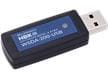
MicroStrain by HBK WSDA®-2000 Gateways for Wireless Nodes
Network-ready gateways for reliable data acquisition.
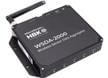
MicroStrain by HBK WSDA-2000 Wireless Sensor Data Aggregators
Supports the MicroStrain LXRS+ wireless communication protocol and all LXRS-enabled modes.