





Murata Noise Occurrence & Suppression Measures in 5G
5G communication services are being rolled out to usher in the latest next-generation communication. But because this communication is found in environments with LTE, Wi-Fi®, and other existing communication systems, more complex noise issues are expected. Before 5G devices fully enter communication environments, Murata studied the noise environments for 5G communication and examined the necessary noise suppression.
Potential 5G communication issues

The effect of existing wireless communications on 5G communication remains unclear.
Expected Noise Issues
5G communication environments are not expected to be used exclusively but rather added to existing communication environments. In these environments, the spurious emissions generated inside devices due to existing wireless communication can connect to the 5G wireless circuits, causing communication interference.
Actual 5G devices have started to appear on the market, but because it takes time to evaluate using actual devices, Murata envisioned a system where a millimeter-wave circuit (Figure 1, below) was added to a 5G communication circuit. Murata then used frequency multiplier and mixer test boards installed in the circuit to evaluate the effect when external noise connects to a signal line required for operation. In the study, spurious emissions are defined as excess signals other than the communication signals themselves. They include communication signals from other communication and high-order harmonics.
Murata focused on the frequency multiplier and mixer to determine when external noise connects to a signal line.
Figure 1

Study of Signals
In order to discern the circumstances of millimeter-wave circuits coupled with external noise, this phenomenon was reviewed using the evaluation system shown in Figure 2 (below). External noise is coupled with the directional coupler in the LO direction of the substrate, in which the mixer is used to couple the LO and IF signals. 20GHz frequency/15dBm power is entered into the LO signal line and 3.5GHz frequency/0dBm power into the IF signal line. External noise with a frequency similar to that of the LO signal at 19.8GHz and 19.5GHz frequency is entered at 0dBm power.
Figure 2

Evaluation system
The effect when external noise was connected to the LO signal was evaluated.
Evaluation Result
When external noises at 19.5GHz and 19.8GHz were connected, Murata discovered that in addition to the expected 23.5GHz output from the mixer, spurious emissions for the difference between the LO signal frequency and noise frequency were generated (Figure 3, below). In the same manner, the generation of spurious emissions was also confirmed in the frequency multiplier.
Figure 3

Evaluation results (External noise: 19.8GHz, 19.5GHz)
The connection to external noise resulted in spurious emissions.
Note: To evaluate whether these spurious emissions actually affect communication, Murata verified using the communication simulator SystemVue® by Keysight.
Evaluation of Effect of Generated Signals
The SystemVue simulations utilized simplifications of the actual model as shown in Figure 4 (below).
Transmitter Side
A modulated signal for the 5G communication system is output from the BB-IC of the transmitter side. This is combined with the LO signal in the transmitter-side RF-IC to up-convert to a millimeter-wave frequency. The 5G communication signal is then output.
Receiver Side
The transmitted signal is combined with the LO signal in the receiver-side RF-IC and down-converted. Signal demodulation in the BB-IC is performed, and the BER (Bit Error Rate) is calculated.
External noise was connected to the LO signal line in this evaluation system, and its effect was evaluated. The reception sensitivities before and after connecting the noise were compared. The reception sensitivity before noise connection was -96.7dBm, and the reception sensitivity after noise connection was -89.5dBm, indicating a drop in reception sensitivity of 7.2dB.
In this study, the reception power at a BER of 95% was defined as the reception sensitivity. Consequently, this showed that connecting noise to the LO signal line in the mixer and frequency multiplier adversely affected communication.
Figure 4

Evaluation system (SystemVue simulation)
External noise was connected to the LO signal line, and the reception sensitivity (reception power at BER 95%) was evaluated.
SystemVue Simulation Evaluation Results
Murata summarized the mechanisms where interference occurred due to noise (Figure 5, below). Noise connected to the LO signal line enters the frequency multiplier, and spurious emissions are generated. These spurious emissions are combined with IF signals at the mixer, and the 5G signals and frequency band are superimposed. This causes incorrect signals to be transmitted from the antenna, causing a communication error at the receiver side.
For this reason, measures for preventing the entry of noise to the LO signal line are needed for preventing noise interference.
Figure 5

SystemVue evaluation results
Figure 6

Noise Interference Generating Mechanism
- External noise is connected to the LO signal line.
- Noise enters the frequency multiplier, and spurious emissions are generated.
- IF signals enter the mixer.
- This combines with IF signals at the mixer, and the 5G signals and spectrum are superimposed.
Result: Incorrect signals are transmitted by the antenna, and a communication error occurs at the receiver side.
Measures are needed to prevent the transmission of noise to the LO signal line.
Noise suppression method
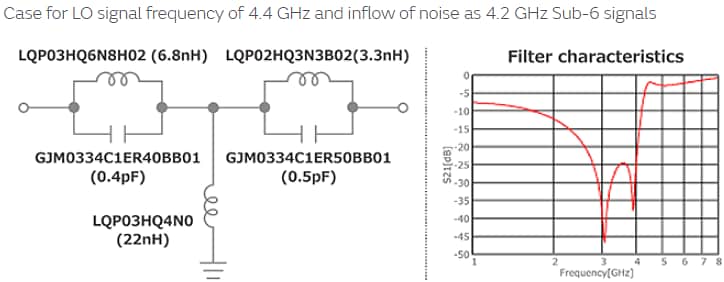
From previous studies, Murata determined noise could be suppressed by preventing the inflow of noise to the LO signal line. Specifically, in this method, a filter for removing the noise frequency band is installed in the LO signal input line of the IC that generates the millimeter-wave (Figure 7, below). The filter combines an inductor and capacitor, and these elements must be set based on the target noise frequency.
Figure 7

5G Noise Suppression Method


Conclusion
In 5G wireless circuits, the inflow of high-frequency signals to the LO signal line generates spurious emissions in the frequency multiplier and mixer. This can lower signal quality, potentially resulting in a communication error.
To suppress this noise, a filter that prevents the inflow of noise to the LO signal line must be installed. The appropriate constant must be chosen for this filter through consideration of the LO signal frequency and noise frequency.
Videos
Additional Resources
SimSurfing Tool

Murata SimSurfing Tool
A free website design tool that provides information and data for selecting electronic components.
Community Forum
Murata Community Forum provides searchable content with various discussion topics, popular blogs, and articles. The Murata broad market support team holds regular reviews to discuss open issues, allowing inquiries to be answered in a timely manner. The forum content is freely accessible to the public. However, users must log in to post questions or answers. Registration is free of charge.
Learn More

Murata EMI Noise Suppression
Provides engineers with complete support, including products & design-simulation software solutions.
Related Products
Murata Electronics LQP RF Film Type Inductors
Offered in a case size range from 01005 to 0603, supporting the trend toward miniaturized sizes.