




Prokyber Esp32-C6-Bug RISC-V Zigbee® Development Board
Prokyber Esp32-C6-Bug RISC-V Zigbee® Development Board features the Esp32-C6FH4 RISC-V MCU. The Prokyber Esp32-C6-Bug supports multiple wireless protocols, including Wi-Fi 6, BLE 5, Thread, and Zigbee. It is suitable for various applications, and with low power consumption and battery support, it's ideal for energy-efficient projects requiring wireless connectivity.
The ESP32-C6-Bug has castellated holes for easy integration into products and fits neatly on a breadboard for prototyping. The device has a built-in 32.768kHz RTC oscillator that ensures accurate timekeeping. The board's low power consumption of 20µA in sleep mode extends battery life. It supports programming with the Arduino framework and ESP-IDF.
Features
- Chip features
- 32-bit RISC-V 160MHz processor
- 32-bit RISC-V 20MHz low-power coprocessor can run tasks even when the main system is in deep sleep state (example)
- 512MB SRAM, 4MB Flash
- Wi-Fi 6, BLE 5 + IEEE 802.15.4 radio (Zigbee, Thread, etc…)
- 2.4GHz Wi-Fi 6 (802.11ax) radio also supports 802.11b/g/n for backward compatibility
- SPI, UART, I2C, I2S, RMT, TWAI, PWM, SDIO, motor control PWM, 12-bit ADC, and a temperature sensor
- Mechanical
- User-controlled LEDs
- External 32.768kHz RTC oscillator and 40MHz oscillator
- Reset and user-controlled buttons
- 700mA low-noise LDO
- USB Type-C™ for programming and communication
- 19x GPIOs exposed
- Battery features
- Under-voltage and reverse-polarity protection
- Onboard battery charging and level measurement with indicator LED
- 20µA deep sleep power consumption (with timer wake-up)
- Form-factor
- Castellated holes
- Pin names on both sides
- Breadboard compatible
- Two M1 mounting holes
- Esp32-Bug-Eth add-on board features
- W5500 Ethernet module
- Isolated PoE support provided by SDAPO DP1435-5V module
- STEMMA-QT connector for connecting peripherals
- USB Type-C supporting both power and data
- M2 mounting holes
Applications
- Multiprotocol USB-Zigbee/Thread/Matter dongle
- Wi-Fi-Openthread router
- Wi-Fi-Zigbee gateway
- Ethernet-Zigbee/Thread/Matter bridge
- Light switch and Bulb control via Zigbee
- Building multi-protocol devices
- Wearable electronics
- Protocol bridges
- Smart home devices

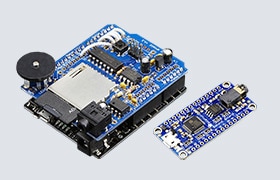
The Esp32-Bug-Eth companion board enhances the Esp32-C6-Bug's capabilities. This add-on supports Ethernet and PoE using the W5500 Ethernet chip, and DP1435-5V isolated PoE module. It also features a Stemma QT/QWIIC connector for easy sensor integration.

Videos
Pinout

Overview

On-Board Features

Related Products

Espressif Systems ESP32-C6 Ultra-Low-Power System-on-Chips (SoCs)
Support Wi-Fi 6 in the 2.4GHz band, BLUETOOTH® 5, Zigbee® 3.0, and Thread 1.3.

WIZnet W5500 Ethernet ICs 3-in-1 Controller
Providing easier Internet connections to embedded systems.

Adafruit ATECC608 Breakout Board
A crypto-authentication chip designed to lock away private keys securely.
Examples
Zigbee Light Bulbs/Switches
Create Zigbee devices like light bulbs and switches using Espressif's Zigbee example.

Thread to Wi-Fi Bridge
Espressif’s Thread example demonstrates how to access Thread network devices via Wi-Fi using the Esp32-C6-Bug. Add the Esp32-Bug-Eth shield for Ethernet connectivity and PoE powering.

Zigbee Sleepy Device
This Zigbee example utilizes low-power sleep modes with Zigbee for battery-powered devices, for power consumption as low as 60µA when in sleep mode.

Ethernet + PoE Multi-Protocol Bridge
While Esp32-C6 doesn't have native Ethernet RMII, it does support popular Ethernet chips like W5500 via SPI, which can be facilitated by the Esp32-Bug-Eth shield.

STEMMA QT POE-Powered Sensors
Power STEMMA QT sensors with PoE for convenient integration. The following image demonstrates the ATECC608A cryptographic chip development board and library configuration.

Esp32-C6-Bug Smart Home Devices
The Esp32-C6-Bug is fully compatible with the Home Assistant environment using ESPHome. Home Assistant SkyConnect also supports connection via Zigbee using this ESP-IDF light example, which is described in the Esp32-C6-Bug datasheet. Other integration options are possible using ESPHome .yaml scripts. The video below demonstrates the use of Home Assistant SkyConnect with a touchscreen and Esp32-C6-Bug.

Small Battery-Powered Devices
Benefit from built-in battery support and low-power features for applications like fitness trackers, virtual reality controllers, and BLE speakers. External 32kHz crystal allows light sleep during BLE advertising, effectively dropping the power consumption to 200µA.